I’m Not “Too Emotional.” I’m Imagining Your Dog.
 Linda Kwoun
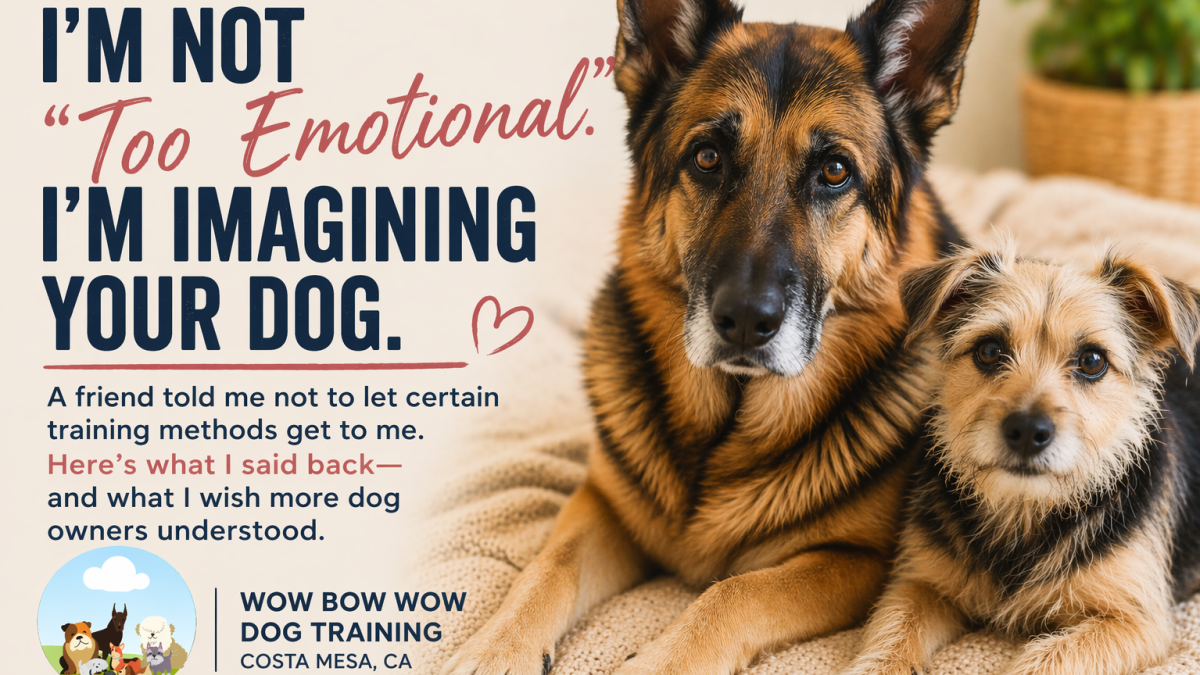
A friend told me not to let certain training methods get to me. Here’s what I said back — and what I wish more dog owners understood.
A friend once told me not to let certain dog training methods get to me.
She meant well.
I had been sharing a story with her — something someone else had told me about how they had “handled” their dog’s behavior.
And I could feel myself getting emotional as I talked about it.
Not because I was trying to make a point.
But because I was picturing the dog.
She listened, and then gently said,
“Try not to let it get to you. It’s just a different approach.”
And I answered her.
I told her:
I’m not just reacting to a method.
I’m picturing your dog.
The more I thought about that conversation, the more I realized—
This isn’t just a one-on-one moment.
This comes up all the time.
So I’m sharing it here.
Because if you’ve ever felt something in your chest when you hear certain advice about dogs…
You’re not alone.
My friend saw one conversation.
What she didn’t know is that it wasn’t the first.
Let me be honest about my reaction
If someone treated my current dogs, Danny and Jill, that way…
My reaction wouldn’t be calm.
If I’m being completely real with you—
If someone used fear, pain, or pressure on them to force compliance…
I’d want to go full mama bear.
I’ll leave the details to your imagination and just say:
It wouldn’t be pretty.
I’m a dog trainer. I know how to regulate myself.
But that protective instinct?
I don’t want to turn it off.
Because it comes from the right place.
My reaction isn’t just about disagreeing with a methodology.
It’s about picturing a specific dog—
Often a dog I know and love—
Experiencing something frightening or painful with no way to make it stop.
That’s not a philosophical debate.
That’s a gut punch.
I didn’t start here
Here’s what I need you to know about me:
I haven’t always been where I am now.
With my first dog, Jack, I was doing what so many people do—
I was listening to the professionals I trusted at the time.
I worked with trainers who told me to be more “assertive.”
To show him who’s in charge.
I was told to alpha roll him.
I was told to pop the choke chain.
And I did.
Not because I wanted to hurt him—
But because I thought that was what you were supposed to do.
The trainers who told me to do it weren’t cruel people either.
They were passing on what they’d been taught.
Just like I was following what I’d been told.
I remember one moment so clearly.
I alpha rolled Jack…
And he yelped.
I can still hear it.
I never did it again.
And to this day, that moment still makes me cringe.
It still brings up a surge of guilt.
That was a turning point for me—
Not because someone argued me into a different philosophy,
But because I felt it in my body.
Something about that didn’t sit right.
And once I felt it…
I couldn’t unfeel it.
Why I’m telling you this
I’m sharing this because I know I’m not the only one.
Most people don’t set out to do something harmful.
They follow the advice they were given.
They trust the experts.
They try to do the right thing for their dog.
I did too.
So if you’ve tried something in the past that doesn’t feel aligned with who you are now—
You’re not alone.
And you’re not stuck there.
But once you see it differently—
Once you really understand what your dog might be experiencing—
It’s very hard to go back.
That’s why this isn’t just a difference of opinion for me.
Because I’ve been on both sides of it.
And I know which one I will stand behind.
The part that hit differently
Here’s what made certain moments especially hard:
Some of the people sharing these stories were proud.
They were telling me—
their dog listens now—
Expecting me to validate what they’d done.
And in some cases, they were talking about dogs I’ve worked with.
Dogs I have a relationship with.
Dogs whose faces I know.
And to be fair—
These aren’t bad people.
They were trying to help their dog using tools our culture has long treated as normal.
They thought it worked.
And in those moments, I try to respond thoughtfully.
Because I understand what’s underneath it.
Most of the time, it’s not coming from a bad place—it’s coming from frustration. From wanting things to work faster. From feeling like what I shared didn’t get results quickly or easily enough.
So instead of reacting, I ask questions.
I’ll ask, “Why do you think that tool or method worked?”
Because I want them to think about it—not just repeat what they were told.
I remember one past client telling me their dog was scared of the new trainer.
They said it almost as proof that the training was working.
And I felt my stomach drop.
So I asked them—
“Do you think it’s a good thing that your dog is scared of the trainer?”
Like I said—I’m professional.
I can hold that space.
I can stay in the conversation.
But internally…
I’m somewhere between heartbreak and fury.
On behalf of a dog who never got a voice in any of it.
So no — this isn’t “just a different approach” to me
I’m not someone who believes there’s only one way to train a dog.
There’s nuance.
There are different tools and techniques.
I hold my views with humility.
I don’t need everyone to do things my way.
But when a method involves a dog being frightened or hurt into compliance—
When a dog who trusts us ends up feeling confused, shut down, or unsafe—
That’s not just a difference of opinion.
That’s an experience being done to a living being who deserved better.
I believe in boundaries.
I believe in clarity.
I just don’t believe fear or pain should be part of how we get there.
Because yes—
Some dog training methods can stop behavior.
That doesn’t mean they’re building trust.
This is also about you
My dog Jack was once asked to leave a group class for excessive barking.
I know what that feels like—
The embarrassment.
The judgment.
The feeling that your dog is just too much.
I know what it’s like to try to fix it.
I know what it’s like to get advice that doesn’t feel right…
And follow it anyway—
Because you don’t know what else to do.
If you’re reading this and feeling something in your chest—
Maybe you’ve tried things that didn’t feel right.
Maybe you’ve followed advice and later thought,
I wish I had known another way.
Most of us start with what we were handed.
Most of us shift once we know better.
You’re not alone.
And you’re not stuck.
What I want you to take from this
If this resonates with you—
You’re not looking for just any trainer.
You’re looking for someone who sees your dog the way you do.
You’re not hiring someone to suppress behavior at all costs.
You’re hiring someone to help your dog feel safe enough to learn, think, and make better choices.
Someone willing to sit with discomfort.
To stay in the gray.
To work through the nuance.
Dogs come to us already trusting us.
They already believe we are safe.
The least we can do is spend the rest of their lives proving them right.
That’s the work.
That’s why I do this.
And yes—
It means some things will always hit me somewhere past the level of “difference of opinion.”
I’m okay with that.
Honestly?
I think you should want a trainer who feels it that way.